Meal Planning From Your Own Family Cookbook (Not a Stranger's Blog)
Most meal planners suggest recipes nobody in your house has agreed to eat. Planning from dishes your family already likes removes the hardest step.
Best starting point
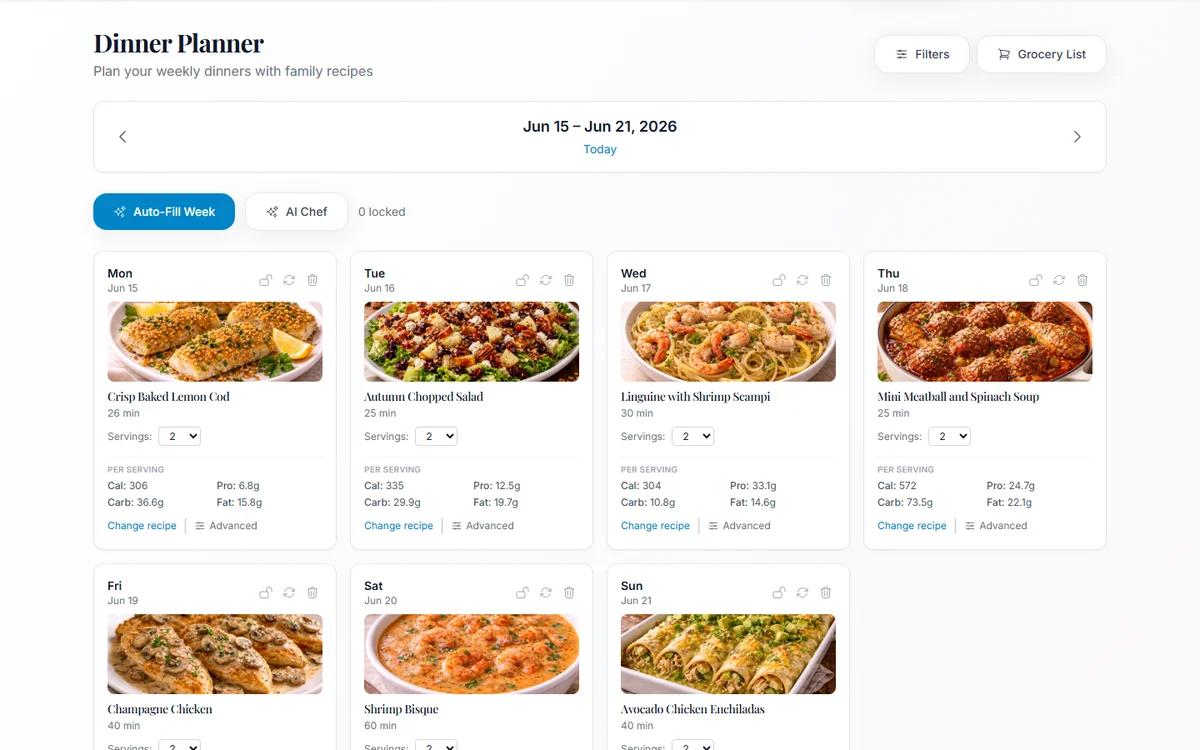
Use the meal planner to bring preserved recipes back into the weekly dinner routine.
Recipes We Share connects saved recipes to weekly planning, nutrition context, serving adjustments, and grocery lists so the family cookbook becomes useful on ordinary nights too.
In Recipes We Share
- Choose recipes from the family cookbook for each dinner slot.
- Use nutrition and time details to balance the week.
- Turn planned meals into a grocery list when it is time to shop.
What this guide helps you decide
- How to build a realistic week from family favorites.
- How to use nutrition as context without overcomplicating dinner.
- How to keep preserved recipes in active rotation.
Most meal-planning apps have the same flaw: they solve the easy problem.
Finding recipes is not hard. There are more recipes online than anyone could cook in ten lifetimes. The hard part is deciding, at 5pm, in a house where one person will not eat mushrooms and another has football at 6.
Suggesting a Moroccan tagine you have never made, from a blog you have never read, does not help with that. It adds a decision.
The rotation nobody writes down
Every family already has one. Somewhere between eight and fifteen dinners that get cooked over and over, because everyone eats them, the ingredients are in the shop, and nobody argues.
That list is the most valuable meal-planning asset in the house, and almost nobody has it written down. It lives in one person's head and gets reconstructed nightly under time pressure.
Write it down and most of the problem disappears.
Why planning from your own recipes works better
No convincing required. You already know it gets eaten. That is information no recommendation engine has.
You know the real timings. Not "30 minutes" from a blog — your thirty minutes, in your kitchen, with your oven. The recipes you have cooked carry accurate times.
Shopping is predictable. A rotation of familiar dishes uses overlapping ingredients. Planning from twelve unfamiliar recipes means twelve part-used jars.
Nobody negotiates. The tagine invites debate. Tuesday-is-tacos does not.
Setting up a rotation in one evening
1. List what you actually cook. Not what you wish you cooked. Ask the household — "name a dinner we have" — and you will hit ten in about four minutes.
2. Sort by effort. Three buckets: under 30 minutes, weekend, and low-effort fallback (the thing you make when nobody wants to cook). Every family has the third and it belongs in the plan.
3. Assign by night, not by dish. Do not plan seven dinners. Decide what kind of night each one is. Monday is fast, Wednesday is leftovers, Friday is easy, Sunday is the one that takes time. Then dropping a dish into a slot is trivial.
4. Plan five, not seven. Something will happen. Someone will be out, or you will get a takeaway. Seven-day plans collapse by Wednesday and people conclude planning does not work for them. Five is achievable, and the slack is the reason it survives.
5. Generate the list from the plan. Not from memory in the shop.
Where a shared cookbook helps
If the recipes live in one shared place, anyone can plan — not only the person who remembers them all. Someone else can look at Thursday, see it is empty, and put something in.
Scaling matters too: cooking for four normally and nine at Christmas is the same recipe with different numbers, and doing that arithmetic by hand at the counter is how people end up with half a tin of tomato purée and no plan for it.
And if you want to know roughly what a family recipe contains nutritionally, that only works when the recipe is stored as structured ingredients rather than a photo or a paragraph. We only show a figure when it can be worked out reliably; where it cannot, we say so rather than inventing one.
Filling the gaps
Most families are three or four dishes short of a comfortable rotation — enough dinners to avoid repeating within a fortnight.
Rather than trawling blogs, take them from a set already written for weeknights: Weeknight Beef and Broccoli, Sheet Pan Chicken Fajitas, One Pot Lemon Chicken Orzo, 15 Minute Honey Garlic Salmon, and Slow Cooker Beef Stew for a day you will not want to cook.
Add three, cook each once, keep the ones that worked. That is how a rotation grows — one dish at a time, tested.
The honest limit
Meal planning fails for most people not because the tool is wrong but because the plan is too ambitious. Five dinners from recipes you already know beats seven from recipes you do not, every week, without exception.
Start with what your family already eats. Write it down once. Then the 5pm decision is already made.
Start free — build the rotation, plan the week, and generate the shopping list from the plan rather than from memory.
Plan from recipes you already trust
Use Recipes We Share to turn preserved recipes into this week's dinners
Pick family recipes for the week, adjust servings, review nutrition context, and use grocery lists when it is time to shop.
- Plan dinners from your own family cookbook
- Use calories, protein, carbs, and fat as planning context
- Create grocery lists from planned meals
On this page
Related posts
More articles in guides to keep the momentum going.
Get Your Holiday Ingredient Math Right Before the Holiday
Recipe cards say "a turkey," "a can of pumpkin," "a stick of butter" — not grams. Work out the real weights for your Thanksgiving and Christmas baking menu now, while there's still time to shop and scale with confidence.
How to Make a Printed Cookbook From Family Recipes
A practical guide to turning scattered family recipes into a real printed book — what to include, how to order it, and the mistakes that cost reprints.

The Recipe Box Audit: What to Digitize First (With a Weekend Plan)
You will not scan four hundred cards. Here is how to sort a recipe box by what is actually at risk, and digitize the irreplaceable ones in a weekend.