Cozi vs. Recipes We Share: Family Calendar or Family Cookbook?
Cozi organizes your family's schedule. A family cookbook preserves what your family cooks. Here is which problem each one actually solves.
Best starting point
Use Recipes We Share for the working system, then use this guide to make better decisions.
The strongest archive combines product workflow with family judgment: the app handles structure, search, sharing, and AI assistance while your family adds context no tool can invent.
In Recipes We Share
- Capture the original recipe and create a clean version.
- Organize it so relatives can find and use it.
- Add memories, comments, and versions as the recipe evolves.
What this guide helps you decide
- What to prioritize first.
- Where manual judgment matters.
- How to avoid a system your family will abandon.
People usually arrive at this comparison already using Cozi, having filed a few recipes in it, and wondering whether they need anything else.
Short answer: these tools solve different problems, and the recipe box in Cozi is a convenience feature rather than an archive. Whether that matters depends entirely on what you are trying to keep.
What Cozi is for
Cozi is a family logistics app, and a well-regarded one. Shared colour-coded calendar, shopping lists, to-dos, and a recipe box that feeds the meal planner and pushes ingredients onto the grocery list.
That loop — plan the week, generate the list, everyone sees it — is the product. The recipe box exists to serve the calendar.
If your problem is "nobody knows who is picking up whom on Thursday, and we need milk", Cozi is a genuinely good answer.
What a family cookbook is for
A dedicated family cookbook solves a slower problem: the recipes your family actually cooks are scattered and quietly disappearing. Index cards in a drawer. A photo in someone's camera roll. A text thread from 2019. Your grandmother's handwriting on a card nobody can find.
The job is not this week's dinner. It is making sure that in thirty years someone can still make the thing.
Where the difference shows up
Handwritten cards
This is the clearest split. A recipe box built for meal planning expects you to type a recipe in. It has no reason to care that the original was handwritten.
But for most families the handwriting is the artifact. The card in your grandmother's hand, with the splatter on it and the note in the margin, carries information the typed version loses completely. A cookbook built for preservation scans it, keeps the image alongside the text, and treats the card as part of the record.
Who wrote it, and what they said about it
"Aunt Karen's, and she insists on the yellow mustard, not Dijon" is not a field in a meal planner. In a family cookbook it is the point — attribution, notes, and the story attached to the dish.
What happens to the collection long-term
A logistics app is built around the current week. Old entries are not really the concern. An archive is built the other way around: the value increases with age, and the collection is meant to be inherited.
Where recipes come from
Cozi expects manual entry or a simple import. A cookbook built for family recipes has to handle the messier real sources: photos of cards, screenshots, a relative's text message, a recipe read aloud over the phone.
Where Cozi is better
- The shared calendar. Genuinely excellent, and a cookbook does not replace it.
- One app for the household's whole schedule. Fewer tools is a real benefit.
- Free tier that covers a lot. Most families never pay.
- Weekly logistics loop. Plan, list, shop — tight and well built.
Where a family cookbook is better
- Handwritten and inherited recipes, kept as images plus text.
- Multiple contributors adding their own dishes, with attribution.
- Stories and photos attached to the recipe.
- Printing a real book from the collection.
- Nutrition you can trust on family recipes, not just packaged ones.
Most families want both, and that is fine
There is no conflict here. Cozi runs the week. The cookbook holds what the family cooks and where it came from. They answer different questions and coexist without friction.
If you have to start with one, start with whichever problem is actually hurting:
- Missed appointments and forgotten groceries → Cozi.
- A box of your grandmother's cards in a closet that nobody has photographed → a family cookbook, and start soon. That box is the part with a deadline.
If you are starting the cookbook
Do not begin by typing in everything you have ever cooked. Begin with what exists in only one place — the handwritten cards, the recipes nobody has published. The recipe box audit walks through choosing what to do first.
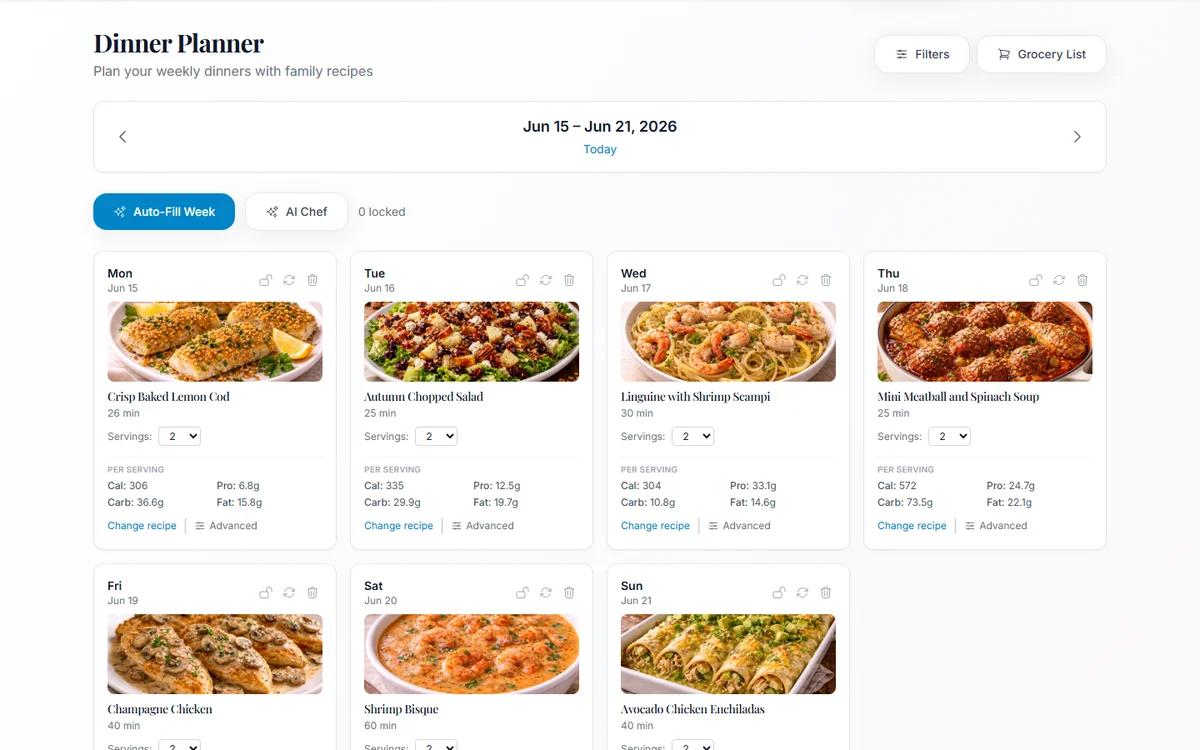
You will not be looking at an empty book while you work: everyday staples like Sunday Chicken Pot Pie, Taco Night Beef Tacos and Saturday Morning Pancakes are included from the start, so the planner is useful on day one.
Start free — no credit card. Keep using Cozi for the calendar; it is better at it.
Ingredient weights mentioned in this guide
Put the process into practice
Use Recipes We Share to save the recipe and the story around it
The platform is designed for the full workflow these articles describe: capture the original recipe, refine it into a clean version, save the notes and memory behind it, and share it with family in one place.
- Preserve the original image and the cleaned recipe together
- Attach memories, notes, and context while the details are still available
- Share the finished recipe with family instead of passing it around manually
On this page
Related posts
More articles in guides to keep the momentum going.
Get Your Holiday Ingredient Math Right Before the Holiday
Recipe cards say "a turkey," "a can of pumpkin," "a stick of butter" — not grams. Work out the real weights for your Thanksgiving and Christmas baking menu now, while there's still time to shop and scale with confidence.
How to Make a Printed Cookbook From Family Recipes
A practical guide to turning scattered family recipes into a real printed book — what to include, how to order it, and the mistakes that cost reprints.
Meal Planning From Your Own Family Cookbook (Not a Stranger's Blog)
Most meal planners suggest recipes nobody in your house has agreed to eat. Planning from dishes your family already likes removes the hardest step.